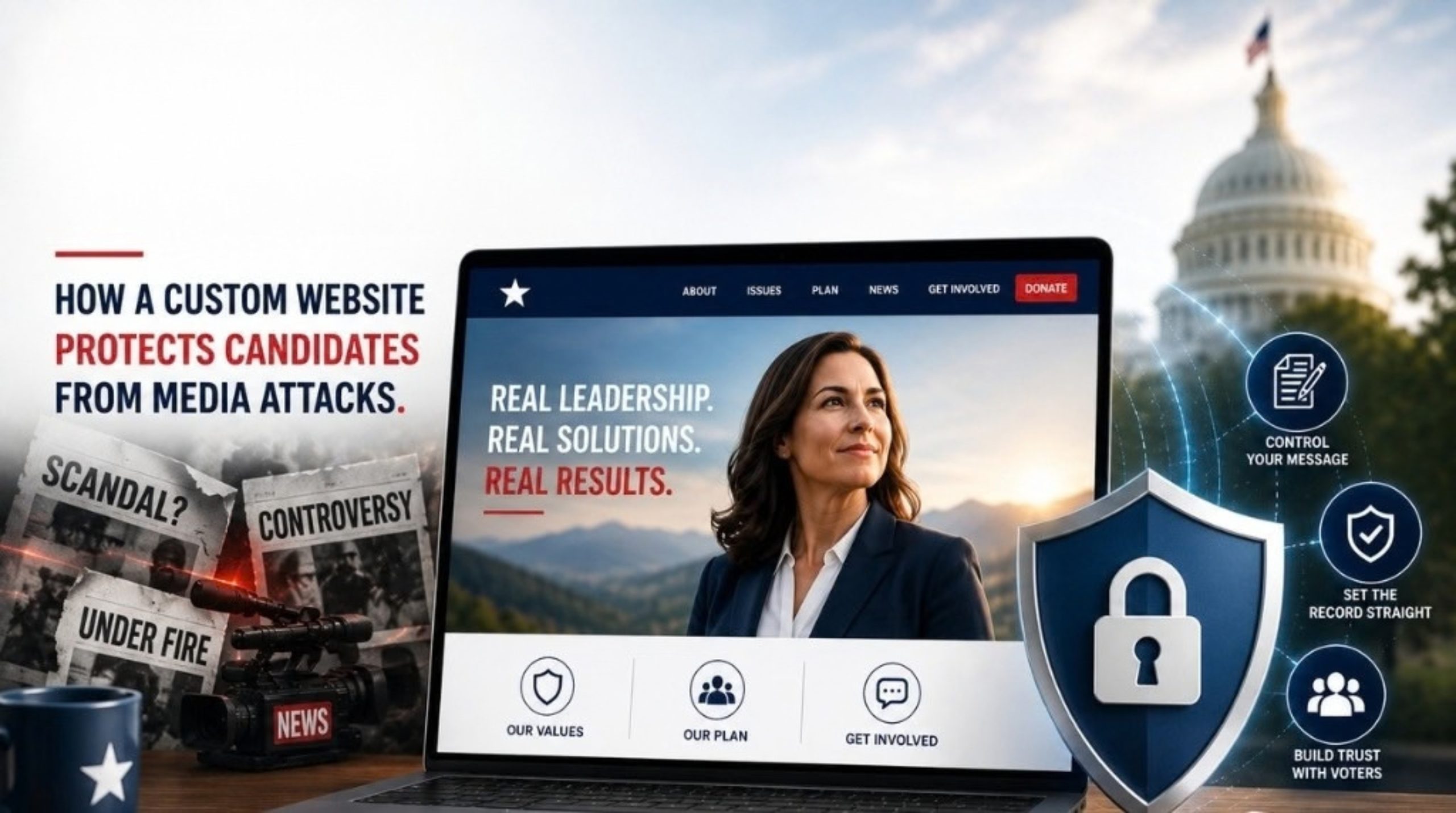
How a Custom Website Protects Candidates from Media Attacks
One Missing Domain, One Bad Morning
When Carly Fiorina announced her presidential run in May 2015, voters searching for her quickly found a page she didn't control. Her campaign had never registered carlyfiorina.org, and a critic used it to post a sad face for each of the 30,000 workers laid off during her years leading HP.
Nobody hacked anything. Her team simply didn’t buy the domain in time. The critic had registered it months earlier, in December, while she was still visiting early election states.
The lesson is simple: if you don’t own your name online, someone else will, and they’ll tell your story first.
Why This Matters More Than Ever
Voters don’t trust the media to tell your story. Only 28% of Americans now trust newspapers, TV, and radio to report the news fully and fairly, down from 40% in 2020. So voters look for answers themselves, and whatever they find first becomes the truth.
Attacks spread faster than corrections. An MIT study published in Science found that false news online spreads further and faster than the truth, especially political news. Falsehoods were 70% more likely to be reshared than the truth.
AI now answers voters’ questions for them. When Google shows an AI summary, users click a regular search result only 8% of the time, compared to 15% without one. Those summaries most often pull from Wikipedia, YouTube, and Reddit. If your official website isn’t clear and complete, AI will describe you using someone else’s version of events.
The 3 Biggest Threats to Your Narrative
1. Fake and Look-Alike Websites
Critics and bad actors buy versions of your name you forgot to register. The FBI and CISA have warned that fake election sites often use a slightly misspelled word or a different ending, like .com instead of .gov. These fakes can spread false information and steal personal data from your supporters.
2. Deepfakes
Two days before the 2024 New Hampshire primary, voters received robocalls using an AI-cloned version of President Biden’s voice telling them not to vote. The consultant behind it paid just $150 to make the recording.
The FCC issued a $6 million fine, but a New Hampshire jury later acquitted him of all criminal charges, and he said he won’t pay the fine. The takeaway: courts and regulators move too slowly to protect you during an election. Your defense has to be in place before an attack, not after.
3. Empty Space Online
The most common threat is the quietest. When a candidate has no detailed bio, no clear positions, and no press page, reporters and AI tools fill the gap with whatever they find. Empty space online never stays empty for long.
What Winning Campaigns Do: The "Fight the Smears" Example
In 2008, Barack Obama’s campaign faced a wave of false online rumors about his faith and background. Instead of ignoring them, the campaign launched a website called Fight the Smears.
Each rumor was answered with proof. For example, the site showed video of Obama leading the Pledge of Allegiance to disprove claims that he refused to say it. Supporters were encouraged to email the facts to friends. The site worked because it gave an official answer to people already Googling the rumors.
It worked well enough that John McCain’s campaign soon launched its own rapid-response “Truth Squad” site. The lesson works for every party: the campaign that owns the official answer controls the conversation.
5 Steps to Protect Your Narrative
- Buy your name before you announce. Register your name in .com, .org, and .net, plus common misspellings and versions like YourNameForCongress. Point them all to your main website.
- Make your website the official record. Include a full biography, your positions on key issues, approved photos, and a press contact. When reporters find everything in one place, they use your facts.
- Create a “Get the Facts” page on day one. When an attack comes, answer it there. Lead with the truth, show your proof (documents, video, records), and add the date. Don’t repeat the attack in your headline, because that only spreads it further.
- Build your site so AI can read it. Use structured data (behind-the-scenes code that tells Google and AI who you are and what office you’re running for), keep your details consistent everywhere, and add FAQ sections that AI tools can quote.
- List your official channels. Publish one page with every official account, email, and donation link. Tell voters clearly: if it’s not listed here, it’s not from us. This makes deepfakes and fake accounts much easier to expose.
Quick Self-Check
Ask yourself:
- Do I own my name in .com, .org, and .net?
- Does my website have a full bio, positions, and press kit?
- Do I have a page ready to answer false claims?
- When I ask ChatGPT or Google about myself, does my official site show up?
If any answer is “no,” your story has an opening someone else can use.
How Global Leaders Can Help
At Global Leaders, we build human-crafted websites that help leaders own their story online.
Built for AI and Google: Every site includes structured data, so ChatGPT, Gemini, Perplexity, and Google AI can find and recommend your official information.
Handcrafted by Real Designers: Your story is told in a way that feels authentic to voters and credible to reporters.
Live in 48–72 Hours: Your site is ready fast, before opponents get the chance to define you.
Everything Handled: We set up your domain, hosting, and email for you.
See how Global Leaders builds websites for community leaders.
Executive Q&A:
Buy every version of your name as a domain, build a complete official website, and create a fact-check page before attacks start. List your official channels so voters can spot fakes.
No, but claims that are spreading should be answered quickly with proof on your own website. Lead with the facts instead of repeating the accusation.
Post every official video and statement on your own website first, and keep a page listing your official channels. When a fake appears, point voters and reporters to your real record.
Every campaign faces attacks. The candidates who come through them are the ones who built their official record before anyone else could define them.